
Roofing & Exterior Drainage in Wilmington, DE | Rain Drainz
GET YOUR FREE QUOTE
If water is getting into your Wilmington home, through the roof, down the walls, across the foundation, or up from the ground, it’s not a fluke. It’s a pattern that thousands of Wilmington homeowners deal with every year, and it gets worse the longer it goes unaddressed.
Why Wilmington Homes Are Harder to Protect Than Most
Wilmington’s housing stock creates water management challenges that most other Delaware cities simply don’t face. Here’s what makes roofing and exterior drainage in this city more demanding:
- 🏚️ Older Homes, More than 42% of Wilmington homes predate 1939. Most were never designed for today’s rainfall volumes or freeze-thaw intensity.
- 🌧️ Heavy Rainfall, Wilmington receives 45+ inches of rain annually. Combined with 40+ freeze-thaw cycles each winter, roofs and gutters wear faster here than in drier regions.
- 🌳 Dense Tree Canopy, Mature oaks, sweet gums, and pines in neighborhoods like Quaker Hill, the Highlands, and Trolley Square overwhelm gutters within weeks of peak fall season.
- 🏘️ Row Home Construction, More than half of Wilmington’s homes share walls, rooflines, and drainage paths. One failing gutter doesn’t stay one property’s problem.
- 🌊 Terrain Extremes, Wilmington sits on the Fall Line. The city’s eastern blocks near the Christina River sit just 3 to 4 feet above sea level. The western neighborhoods rise steeply toward Quaker Hill and Greenville. Both environments demand different drainage solutions.
Rain Drainz is based at 11 Lewis Circle in Wilmington, less than 15 minutes from Downtown, and we build roofing and exterior drainage systems specifically for the properties, the weather patterns, and the terrain of this city.
Why Roofing & Exterior Drainage in Wilmington, DE Is More Complex Than Most Cities
Wilmington sits on the Fall Line, the geographic boundary where the Piedmont hills drop off into the flat coastal plain. Cross east of Market Street toward the Christina River, and the land flattens out almost immediately. Cross back west toward Quaker Hill or the Highlands, and you’re on higher, sloped ground. That single geographic fact creates two completely different roofing and exterior drainage challenges within the same ZIP code.
The neighborhoods closest to the Riverfront Wilmington area and the Christina River corridor, including Southbridge, which sits just 3 to 4 feet above sea level, face flooding pressure from both directions. Rain comes down from the roof. Groundwater and stormwater push up from below. Homes near landmarks like The Queen Wilmington and Hotel du Pont are in dense, lower-elevation blocks where drainage has nowhere convenient to go.
Up in areas like Greenville and North Wilmington, the properties are larger, more spread out, and often surrounded by mature tree canopy. The roofing and exterior drainage challenges are different there, clogged gutters from heavy leaf fall, root intrusion into French drain lines, and downspouts that dump water too close to a foundation on a sloped lot.
Rain Drainz understands both environments because we work in both of them, regularly.
How Rain Drainz Approaches Roofing & Exterior Drainage in Wilmington, DE
We don’t sell a single product. We solve a water problem, from where it lands on your roof to where it exits your property.
Step 1: Roof and Drainage Assessment
We get on the roof. We inspect the decking, the flashing at every transition point, the membrane condition on flat roof sections, the gutter alignment, and the downspout discharge points. On row homes, we also look at wall transitions and parapet conditions, common failure points that get missed in a driveway assessment.
Step 2: Honest Findings, No Upselling
We tell you what we found. If your flat section needs a coating, we’ll say that, not a full replacement. If your gutters just need a cleaning and a hanger adjustment, we’ll say that too. Our reputation in this market depends on giving Wilmington homeowners accurate information, not inflated scopes.
Step 3: Permit-Compliant Work
Roof replacements within the City of Wilmington require a permit under the City’s Land Use and Planning Department, re-roofing, tear-offs, new shingles, and new roofing systems all require one. Gutter work in Historic Districts requires a permit as well. Rain Drainz pulls permits where required. If a contractor skips the permit, that becomes your liability at resale.
Step 4: Integrated Installation
We don’t hand off the drainage to a different crew. Roofing, gutters, gutter guards, French drains, downspout extensions, catch basins, and grading adjustments are coordinated as one system, because that’s how water moves. A new roof that discharges into a failing gutter system hasn’t solved the problem.
Step 5: Final Walkthrough and Documentation
We walk the property with you when the work is complete, show you what was done, and leave you with documentation for your records and your homeowner’s insurance file.
The Roofing & Exterior Drainage Problems We See Most on Wilmington Properties
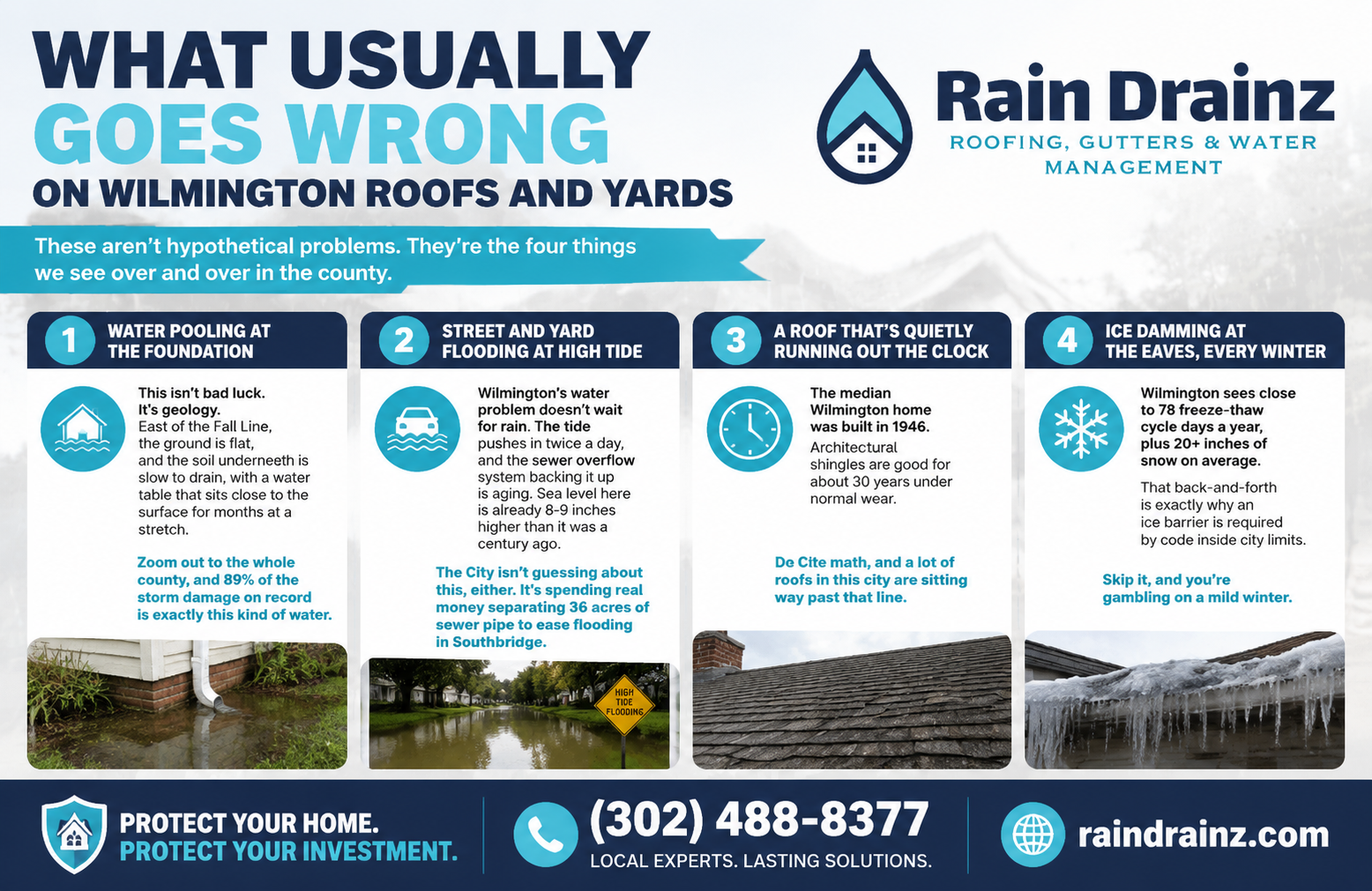
These aren’t hypothetical issues. These are the exact problems our crews encounter on Wilmington properties throughout the year:
Flat and Low-Slope Roofing Sections Holding Water
Row homes in Trolley Square, Quaker Hill, Trinity Vicinity, and Little Italy often have flat or low-slope roof sections connecting their pitched areas. When the membrane on those sections starts to fail, through age, ponding stress, or deteriorated internal drains connected to 80- to 90-year-old cast iron pipe, water finds a ceiling fast. The failure doesn’t always announce itself until there’s already a stain inside.
Freeze-Thaw Flashing Failure
Wilmington crosses the 32-degree mark in both directions approximately 40 times each winter. Every cycle pushes moisture deeper into any opening that salt air, age, or impact has already created around chimney bases, pipe boots, dormers, and valley seams. Most of our late-winter and early spring repair calls in neighborhoods like the Highlands and Forty Acres trace back to flashing damage that developed quietly through December and January.
Gutters Overwhelmed by Mature Tree Coverage
Wilmington’s older neighborhoods are heavily treed, one of the things that makes areas like Quaker Hill and the Greenville corridor beautiful, and one of the things that destroys gutters by October. A single mature oak can deposit enough leaf mass to completely block a 5-inch gutter system within two weeks of peak fall. When that gutter overflows consistently, the water saturates the fascia board, softens the soffit, and begins working toward the interior wall. Gutter guards matched to your specific canopy type can prevent this cycle entirely.
Foundation Drainage Failures in Low-Lying Areas
Properties near the Riverfront, along the Christina River corridor, and in lower-elevation sections of the 19801 ZIP code face hydrostatic pressure from the water table in addition to surface water from storms. French drain systems and downspout extensions that worked adequately ten years ago may no longer be sufficient as storm intensity increases and older drainage infrastructure around them deteriorates.
Gutter Sections Separating or Pulling from the Fascia
Ice dam formation, common on older Wilmington homes with insufficient attic insulation, puts enormous weight and pressure on gutter hangers. In areas like Forty Acres, the Highlands, and Wawaset, we regularly see gutters that have pulled 1 to 2 inches away from the fascia line, creating a gap that sends every drop of roof runoff directly toward the foundation instead of through the downspout system.
Why Wilmington Homeowners Choose Rain Drainz for Roofing & Exterior Drainage
Rain Drainz was founded by Stephen O’Brian on a straightforward premise: water problems don’t stop at the roofline. Most contractors pick a lane, roofing or gutters or drainage, and hand everything else off. Stephen built Rain Drainz to eliminate that gap. By combining roofing, gutters, and exterior drainage under one roof, Rain Drainz gives Wilmington homeowners a single accountable team that protects their property from the ridge cap all the way to the yard.
That founding idea shapes how every project gets handled today.
We’re Based Here, Not Passing Through
Our office is at 11 Lewis Circle in Wilmington. We’re not a regional chain with a Delaware satellite. Stephen and the team drive these streets, know the terrain differences between the lower Christina-facing blocks and the higher Greenville corridor, and are available for a fast response when something urgent comes up. Most Wilmington addresses are 5 to 15 minutes from our base.
A+ BBB Rating, 4.9-Star Customer Reviews
Our reputation in this market is documented, not claimed. We hold an A+ rating with the Better Business Bureau and carry a 4.9-star average across more than 142 customer reviews. Those reviews come from real Wilmington and New Castle County homeowners, not aggregated across a multistate territory.
Licensed, Insured, and Permit-Compliant
Every project is carried out by a licensed and insured team operating under Delaware contractor standards. We pull permits where required by the City of Wilmington or New Castle County. You’re protected, your project is on record, and your insurance coverage is not put at risk.
Full Exterior Water Management, Not Just One Trade
Most roofing companies hand off at the gutter line. Most gutter companies don’t touch the roof. Rain Drainz handles the complete exterior water path: roofing, gutters, gutter guards, siding, French drains, catch basins, downspout drainage, stormwater management, and exterior drainage design. That integration matters because water doesn’t respect trade boundaries.
Experience With Wilmington’s Specific Housing Stock
Row homes, flat roof sections, shared walls, aging fascia boards, historic district requirements, older cast iron internal drains, we’ve worked through all of it across Wilmington’s neighborhoods. That hands-on experience with the actual construction conditions here is something that cannot be replicated by a contractor who mostly works suburban detached homes.
Roofing & Exterior Drainage Services for Wilmington, DE Properties
Rain Drainz provides the following services to Wilmington homeowners and businesses:
- Asphalt Shingle Roofing, Replacement and repair for pitched and standard-slope roofs across all Wilmington neighborhoods
- Flat Roofing, EPDM, TPO, silicone coatings, and full replacement for row home flat sections and commercial buildings
- Roof Repair, Targeted leak repair, flashing replacement, valley sealing, and ice dam damage remediation
- Roof Inspection, Comprehensive assessment with documented findings and photo records
- Gutter Installation, Seamless aluminum gutters sized and pitched correctly for Wilmington’s 45+ inches of annual rainfall
- Gutter Guards, Filtered protection matched to the specific tree coverage and debris profile of your neighborhood
- Exterior Drainage, French drains, catch basins, downspout extensions, yard drainage design, and grading correction
- Stormwater Management, Engineered solutions for properties with chronic standing water, hydrostatic pressure, or low-elevation drainage challenges
- Siding, Exterior wall protection that integrates with your overall water management system
Pricing ranges from approximately $150 for minor repairs to $30,000 or more for full roofing and drainage system installations, depending on scope, materials, and property conditions. Every project is priced after an on-site assessment, not from a rate sheet.
View our Google Business Profile to see our reviews, photos, and how an optimized listing looks in action.
Serving Cornelius and the Greater Lake Norman Corridor
Wilmington Neighborhoods We Know and Serve
Rain Drainz works throughout the City of Wilmington and the broader New Castle County area. Within the city, we regularly serve:
Trolley Square, Dense Victorian-era rooflines with tight valleys and high debris accumulation from the mature canopy along Delaware Avenue and surrounding streets.
Quaker Hill, One of Wilmington’s oldest historic neighborhoods, with pre-Civil War architecture, steep pitched roofs, original slate on some properties, and drainage conditions shaped by centuries of settled land.
Downtown Wilmington (19801), Mixed commercial and residential stock near the Hotel du Pont corridor, where older flat and low-slope roofs on attached buildings are common and drainage infrastructure connects to aging city systems.
Riverfront Wilmington / Christina River Corridor, Lower-elevation properties where surface water and groundwater pressure operate simultaneously during and after storm events.
The Queen Wilmington Area, Dense urban blocks with attached construction, shared drainage paths, and properties where gutter and downspout failures compound quickly.
North Wilmington / Greenville Area, Larger properties with heavier tree coverage, where French drain systems, downspout extensions, and gutter guard installations are the most common scope of work.
Highlands and Forty Acres, Historic detached and semi-detached properties with pitched roofs, steep slopes, and flashing systems that need regular attention under the city’s Conservation District standards.
Wawaset, Established residential blocks with mature canopy and older guttering systems that frequently require full replacement rather than patch repairs.
Little Italy and Trinity Vicinity, Tightly packed row home blocks where flat rear roof sections and shared drainage paths create compounding water management challenges from property to property.
Southbridge, One of Wilmington’s lowest-elevation neighborhoods at 3 to 4 feet above sea level, where surface drainage and groundwater pressure require more engineered exterior drainage solutions than higher-elevation areas.
Get Your Free Roofing & Exterior Drainage Assessment in Wilmington, DE
Water damage in a Wilmington home doesn’t wait for a convenient time to get worse. A flat roof section that’s been ponding since last spring is already compressing the membrane. Gutters pulling away from the fascia line are already directing runoff toward your foundation. Flashing that failed over the winter is already letting moisture into the wall cavity.
The right time to get an assessment is before that damage becomes structural.
📞 Call (302) 488-8377
🟧 Request Your Free Estimate →
We’re based in Wilmington. We know these properties. We’ll give you a clear picture of what’s actually happening, with no pressure and no inflated scope.
Rain Drainz, 11 Lewis Circle, Wilmington, DE 19804
(302) 488-8377
Frequently Asked Questions About Roofing & Exterior Drainage in Wilmington, DE
1. How much does a roof replacement cost in Wilmington, DE?
Roof replacement in Wilmington costs between $7,000 and $22,000 for most residential properties. Asphalt shingles average $4 to $7 per square foot installed. Final cost depends on roof size, pitch, material grade, and decking condition. Flat roof sections are priced separately. Rain Drainz provides a fixed-scope written estimate after every on-site assessment.
2. How long does an asphalt shingle roof last in Delaware's climate?
Standard 3-tab shingles last 15 to 20 years. Architectural shingles last 25 to 30 years. Wilmington’s 40+ annual freeze-thaw cycles and 45+ inches of rainfall accelerate wear compared to drier regions. Proper attic ventilation and annual inspection can extend roof lifespan by 5 to 7 years by catching minor failures before they compound.
3. Does homeowner's insurance cover roof damage in Wilmington?
Insurance covers sudden damage, wind, hail, and fallen trees. It does not cover age-related wear, deterioration, or deferred maintenance. Most Delaware insurers require a licensed contractor’s written assessment and photos to process a claim. Rain Drainz provides documented findings and photo records your insurance carrier needs to move forward.
4. How often should gutters be cleaned on a Wilmington home?
Wilmington gutters should be cleaned a minimum of 2 times per year, late November after peak leaf fall and early spring before storm season. Homes beneath heavy tree canopy need 3 to 4 cleanings annually. Consistently clogged gutters cause fascia rot within 1 to 2 seasons and active foundation damage within 3 to 5 years. Gutter guards can significantly reduce maintenance frequency.
5. What is the difference between a French drain and a catch basin for yard drainage?
A French drain uses a gravel-filled trench with perforated pipe to redirect subsurface water away from a foundation, best for sloped properties. A catch basin collects surface runoff at a low point and channels it through solid pipe to a discharge point. Most Wilmington drainage problems require one or both systems working together.