
Hardwood Floor Wax Removal in Belmont, NC | Good House Floor Care
GET YOUR FREE QUOTE
Your floors remember everything. Decades of paste wax. Years of “mop-and-shine” cleaners. Layer after layer of product built up until the wood underneath disappeared behind a cloudy, dull, yellowed film that no amount of buffing will fix.
If you live in Belmont and your hardwood floors have lost their warmth, if they look hazy in the light, feel sticky underfoot, or have a finish that just won’t come clean no matter what you try, the problem almost certainly isn’t the wood itself. It’s what’s been applied to it over the years.
Good House Floor Care is a family-owned hardwood floor specialist based in Charlotte, NC. We’ve been serving Belmont homeowners for over 35 years. From the bungalows near downtown Main Street to the older homes tucked along the Catawba River corridor, we know what Belmont floors look like, and we know exactly what it takes to restore them.
What Hardwood Floor Wax Removal Is, and Why It Matters for Belmont Homes
Wax removal isn’t a cleaning job. It’s a restoration process.
For decades, paste wax was the standard finish for hardwood floors in American homes. It produced a warm, natural glow and required periodic reapplication. In older Belmont homes, particularly the Bungalow, Craftsman, and Colonial Revival-style houses found throughout the Downtown Belmont Historic District and the established neighborhoods along South Central Avenue and Glenway Street, wax-finished oak floors are still common.
The problem is that wax doesn’t stay clean forever. It attracts and traps dirt. It builds up unevenly. It yellows. And once you try to switch to a modern polyurethane finish, which lasts longer, resists moisture better, and requires far less maintenance, any wax left on the floor will cause the new finish to peel, bubble, or fail to bond entirely.
Here’s what makes Belmont homes particularly prone to this issue:
- Age of housing stock. Belmont’s historic downtown contains 264 contributing buildings, many built between 1850 and 1949. Homes in these neighborhoods were often maintained with traditional wax products for generations.
- Accumulated product buildup. Newer homeowners often use “mop-and-shine” or acrylic-based floor cleaners, not knowing they’re adding a polymer layer on top of an existing wax base. The result is a cloudy, sticky surface that gets worse with each cleaning.
- Piedmont humidity cycles. Belmont sits on a peninsula between the Catawba River and its South Fork, with Lake Wylie just to the south. Humid summers, dry winters, and seasonal moisture swings cause the oak flooring common in area homes to expand and contract, which accelerates wax breakdown and leads to uneven buildup in high-traffic areas.
The only real fix is a full wax strip: chemical solvent application, mechanical removal, and a proper resand and refinish. That’s exactly what we do, and what Anthony Casabona has been doing throughout this region for over three and a half decades.
How We Remove Wax From Belmont Hardwood Floors
Our wax stripping services in Belmont are methodical. There are no shortcuts, and we don’t skip steps.
Step 1, Floor Assessment
Before anything else, Anthony personally inspects the floor to identify the finish type, wax depth, wood species, and any underlying damage. Oak floors in older Belmont homes often carry multiple layers of product from different eras. Knowing what we’re working with determines the right solvent and mechanical approach, and prevents costly mistakes before they happen.
Step 2, Chemical Wax Stripping
We apply a professional-grade solvent, typically mineral spirits-based, to break down and dissolve the wax layer. We work in controlled sections, allowing proper dwell time and removing all residue before moving forward. We never rush this stage. Wax left behind will compromise every step that follows.
Step 3, Mechanical Removal & Sanding
Once the wax is chemically dissolved, we use professional-grade equipment to sand the floor back to clean, bare wood. We progress through multiple grits to ensure a smooth, even surface that’s fully free of any remaining wax residue. A water-pop test confirms the wax is completely gone before any finish is applied.
Step 4, Finish Application
With clean wood exposed, we apply your chosen finish, most commonly a durable polyurethane, in proper coats with appropriate dry time between layers. The result is a finish that bonds correctly, looks beautiful, and holds up for years.
Step 5, Final Walkthrough
Anthony doesn’t leave until you’re satisfied. You walk the floor together, every question gets answered, and the result matches exactly what was discussed from the start.
What Happens If Hardwood Floor Wax Buildup Goes Untreated
A lot of Belmont homeowners try to manage wax buildup on their own. We understand, it’s your home, and you want to handle it yourself if you can.
But there are real risks to waiting, and real consequences to using the wrong approach.
What wax buildup does to your floors over time:
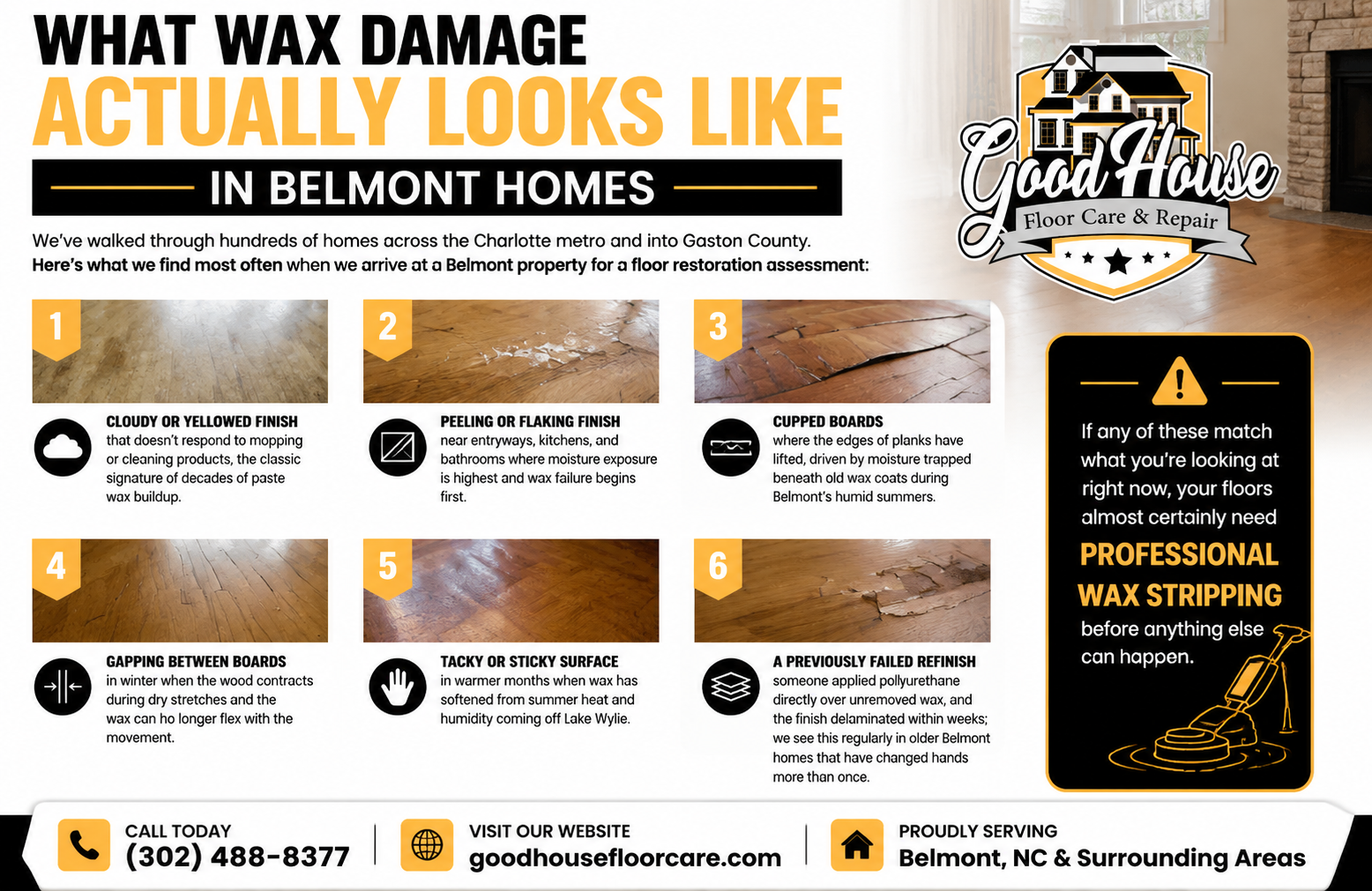
- Dull, hazy appearance, Light no longer reflects cleanly off the surface. The wood grain disappears beneath a flat, yellowed film.
- Sticky texture, Heavy wax accumulation traps dirt and moisture, leaving floors that feel gummy or slow underfoot.
- Trapped damage, Wax seals in scratches, scuffs, and stains rather than protecting against them. Over time, those imperfections become a permanent part of the floor.
- Finish adhesion failure, Any new finish applied over an existing wax layer won’t cure properly. You’ll get peeling, bubbling, or soft spots that wear through quickly.
- Moisture damage acceleration, Wax buildup disrupts the floor’s ability to breathe with seasonal humidity changes. In a river-adjacent, humid area like Belmont, that means faster cupping, gapping, and warping beneath the surface.
The longer wax is left on a floor, the more labor-intensive, and costly, proper removal becomes. Catching it early keeps the project clean and manageable.
Why Belmont Homeowners Choose Good House Floor Care
There are flooring companies in the Charlotte metro area. We’re not the newest, and we’re not the flashiest. What we are is consistent, and that’s what matters when someone is trusting you with the floors inside their home.
Meet Anthony Casabona, Owner, Master Craftsman, and the Person Behind Every Project.
Anthony is a true artisan in every sense of the word. With over three and a half decades of hands-on hardwood floor experience, he has built a reputation in the Charlotte metro that few in this trade can match. He embodies a rare blend of quality, detail, and integrity, values he brings to every home he walks into.
Anthony personally oversees every project from start to finish, ensuring the commitment to the highest level of workmanship and customer satisfaction is never delegated, never compromised, and never left to chance. When you hire Good House Floor Care for restoring wood floors in Belmont, you’re not getting a crew dispatched from a call center. You’re getting Anthony, and that makes all the difference.
- Hardwood specialists, not general contractors. We don’t do tile, carpet, or LVP. We do hardwood floors. That specialization means every technique, every product, and every piece of equipment we use is selected specifically for hardwood.
- Locally owned and family operated. We have a real stake in our reputation. We live and work in this region. When you call (704) 534-7632), you’re talking to someone who answers directly and takes personal responsibility for the outcome of your project.
- Over 350 five-star reviews. Anthony’s clients across Charlotte and the surrounding areas consistently describe the same experience: honest communication, outstanding results, and floors that look better than they ever expected.
- We understand Belmont’s housing stock. The historic bungalows near Stowe Park, the mid-century homes along Catawba Avenue, the older properties near Belmont Abbey College, these aren’t cookie-cutter builds. They have real wood, often original hardwood, and they deserve the care of someone who truly understands what they’re working with. Anthony does.
- 30 to 40 minutes from Charlotte to your Belmont front door. We’re based at 11026 Vista Haven Dr in Charlotte, NC. Belmont is approximately 30 to 40 minutes west via I-85. We schedule efficiently, arrive on time, and we never treat the drive as a reason to charge you more.
Hardwood Floor Wax Removal in Belmont, NC, and the Surrounding Area
Good House Floor Care serves all of Belmont (28012), including the historic downtown neighborhoods, South Point Road corridors, areas near Belmont Abbey College, neighborhoods surrounding Daniel Stowe Botanical Garden, and the residential streets bordering Lake Wylie. We also serve homeowners throughout the surrounding region, including:
- Charlotte, NC, our home base and primary service market
- Gastonia, NC, Gaston County’s largest city, just 10 miles west of Belmont
- Cramerton, NC, immediately adjacent to Belmont along the South Fork Catawba
- Mount Holly, NC, just north of Belmont within the same 28012 zip code area
If you’re in Belmont or anywhere nearby and you’re dealing with dull, wax-coated floors, we’re the call to make.
View our Google Business Profile to see our reviews, photos, and how an optimized listing looks in action.
Serving Cornelius and the Greater Lake Norman Corridor
What You Can Expect After Wax Removal and Refinishing
When stripping wax from Gaston County hardwood is done correctly, the difference is immediate and visible.
- Floors that reflect light again, Clean wood with a proper finish catches natural light the way it was designed to. The warmth and grain of the wood become visible again for the first time in years.
- A surface that’s easy to maintain, Modern polyurethane finishes don’t require waxing, stripping, or specialty cleaners. A regular sweep and occasional damp mop keeps them looking right.
- Floors that respond properly to humidity, Properly finished hardwood breathes better in the Piedmont climate. Seasonal expansion and contraction are normal, but a clean, correctly sealed floor handles it without the cupping and gapping that waxed floors in Belmont’s humid environment often develop.
- Real home value protection, Hardwood floors are a premium feature. In Belmont’s growing real estate market, where median home values in the 28012 zip code exceed $430,000, well-maintained hardwood floors are a genuine asset. Wax buildup left unaddressed erodes both the appearance and the long-term value of your home.
- A result that lasts, A properly stripped and refinished hardwood floor holds its finish for 8 to 15 years under normal residential use. With routine maintenance, you won’t be revisiting this process anytime soon.
Ready to Restore Your Belmont Hardwood Floors? Let's Talk.
Wax buildup doesn’t get better with time. It gets worse, and the longer it sits, the more work it takes to remove it properly.
If your floors look cloudy, feel sticky, or have a finish that no cleaning product will fix, the problem likely isn’t the wood. It’s the layers sitting on top of it. Anthony can remove them, correctly, completely, and without damaging the floor underneath.
Call Good House Floor Care today at (704) 534-7632 to schedule your assessment. Anthony will evaluate your Belmont floors personally, give you an honest answer about what they need, and walk you through the entire process from start to finish.
No pressure. No guesswork. Just a straight answer from a true craftsman who’s been doing this for over 35 years.
Hardwood floor wax removal and refinishing in Belmont, NC typically ranges from 3 to 8 per square foot for full refinishing and 1.50 to 2.50 per square foot for screen and recoat services, depending on floor condition, square footage, and finish selected. Contact us for an accurate quote specific to your home.
Frequently Asked Questions About Hardwood Floor Wax Removal in Belmont, NC
1. How much does professional hardwood floor wax removal and refinishing cost in Belmont, NC?
Full wax removal with refinishing costs 3 to 8 per square foot. A 500-square-foot project typically runs 1,500 to 4,000 depending on wood condition, wax layer depth, and finish selected. Costs increase when multiple wax layers require extended chemical stripping or when damaged boards need replacement. An in-home assessment provides an accurate quote before any work begins.
2. How do I know if my hardwood floors have wax buildup versus a polyurethane finish?
Two safe, simple spot-tests can confirm the presence of wax. First, dampen a clean rag with a small amount of mineral spirits and rub it gently on a hidden section of floor, if wax residue dissolves onto the rag, you have a wax-based finish. Second, drop a few water droplets on the surface; polyurethane causes absorption within 10 minutes, while wax causes water to bead on top. Both tests are safe when performed as a controlled spot-check using a small amount of product on a rag. They take under 15 minutes and cause zero damage to the floor.
3. Can I remove wax from hardwood floors myself, or do I need a professional?
DIY wax removal is not recommended for full-floor stripping. There is an important distinction between a controlled spot-test, which uses a small amount of mineral spirits on a rag, and DIY stripping, which involves applying solvent in large quantities directly across the entire floor surface. That kind of broad application leaves solvent residue deep in the wood grain, causing long-term damage that’s difficult and costly to correct. Professional-grade equipment and 3 to 4 grit progressions are required to remove all wax cleanly across a full floor. Improper DIY removal is the most common reason new finish fails within the first 6 to 12 months of application.
4. How many times can hardwood floors be sanded before they need to be replaced?
Most solid ¾-inch hardwood floors can be sanded 5 to 7 times over their lifetime. Each professional sanding removes approximately 1/16 inch of wood. Engineered hardwood allows 1 to 3 sandings depending on wear layer thickness. A pre-project floor assessment confirms remaining wood thickness and determines whether sanding is safe before any work begins.
5. How long does a refinished hardwood floor last after wax removal?
A properly stripped and refinished hardwood floor lasts 8 to 15 years before needing refinishing again. Water-based polyurethane holds up 5 to 10 years in high-traffic areas. Oil-based polyurethane lasts 10 to 15 years under normal residential use. Annual cleaning with a pH-neutral hardwood-safe product and prompt attention to spills extends finish life significantly between refinishing cycles.